 Jan Slifka
What Happens When a Postdoc Leaves With All the Project Knowledge?
Research projects are often built around people.
A PhD student develops a data collection workflow. A postdoctoral researcher becomes the expert on a dataset. A research assistant learns how to operate a specialized piece of equipment. Over time, these individuals accumulate a vast amount of knowledge that rarely appears in publications, reports, or even official project documentation.
Then one day, they leave.
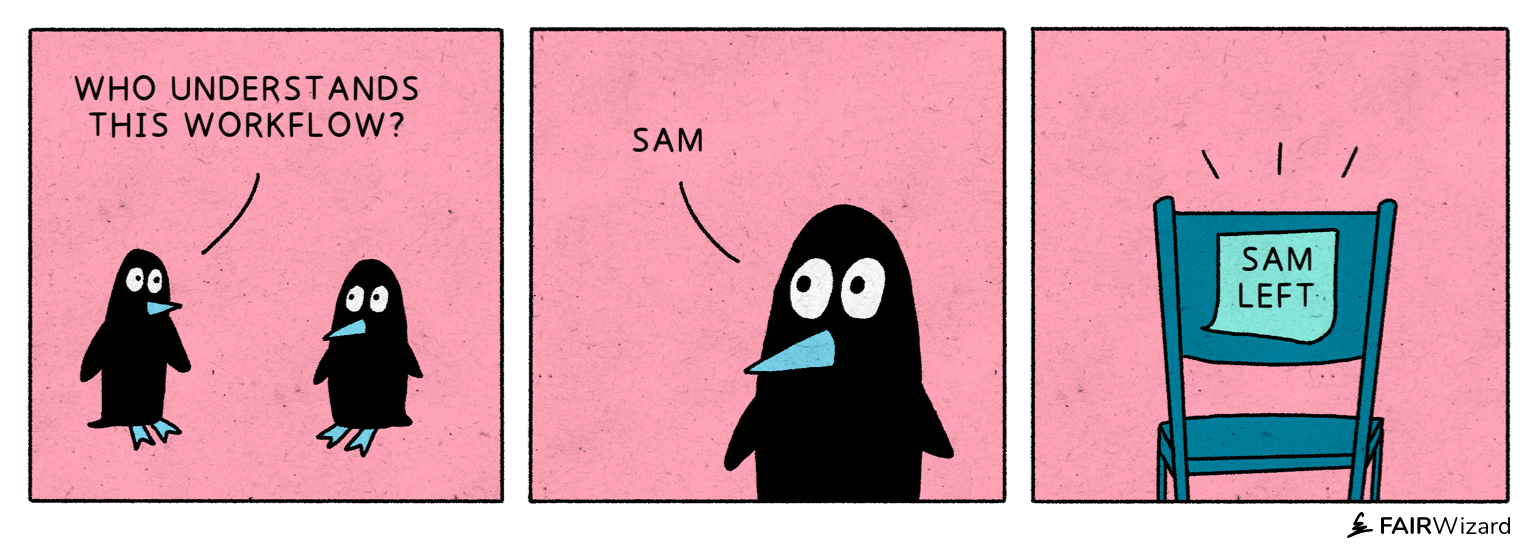
A postdoc accepts a faculty position at another institution. A PhD student graduates. A project manager moves on to a new role.
What should be a normal part of academic life suddenly creates a problem. Team members struggle to locate datasets, understand processing workflows, reproduce analyses, or answer questions from funders and collaborators. Information that was once readily available now exists only in someone’s memory, old email threads, or files stored on a personal computer.
This is one of the most common and costly challenges in research data management, yet it often receives far less attention than technical infrastructure, storage capacity, or compliance requirements.
When people think about research outputs, they usually think about publications, datasets, software, or reports. These are tangible outputs that can be archived, cited, and shared.
However, every successful project also depends on a large amount of contextual knowledge. Researchers know why certain decisions were made, which data cleaning steps were applied, where datasets are stored, which repository should be used, and which limitations need to be considered when interpreting results.
Much of this knowledge never makes it into a publication. Instead, it lives inside conversations, meeting notes, emails, and the minds of individual researchers.
As projects become larger and more collaborative, this creates a growing risk. When key people leave, institutions often discover that critical project knowledge was never documented in a structured way. New team members must spend weeks or months reconstructing workflows, understanding datasets, and identifying who is responsible for what. The result is a significant loss of time, efficiency, and institutional memory.
Research personnel turnover is unavoidable. Most projects involve temporary positions such as PhD students, postdoctoral researchers, and fixed-term project staff. In many cases, the people who know the most about a project’s day-to-day operations are also the people most likely to leave within a few years.
The immediate impact is usually obvious. Colleagues may struggle to find files or understand documentation. However, the long-term consequences are often much larger.
Poor knowledge transfer can delay publications because researchers are unable to reproduce previous analyses. It can create compliance risks when funders request information that is no longer available. It can reduce the reusability of valuable datasets because future users lack sufficient context to understand how the data was created and processed.
In some cases, entire parts of a project effectively become unusable because nobody can confidently explain how they were produced.
This problem becomes even more serious at institutional scale. Universities and research institutes invest substantial resources into creating knowledge, but without proper knowledge management practices, a significant portion of that investment can disappear whenever staff members move on.
Recent discussions in the research community have highlighted how valuable expertise and project context can be lost when researchers leave, creating inefficiencies that affect both individual projects and institutional research capacity. Nature recently discussed the challenge of preserving scientific knowledge and expertise as researchers move between roles and institutions.
Most research teams understand the importance of documentation. The challenge is not a lack of awareness.
The challenge is that documentation is often treated as a one-time administrative task rather than an ongoing process.
A Data Management Plan may be written at the start of a project to satisfy a funder’s requirements. Researchers create shared folders, spreadsheets, and documents. Information is captured in meeting minutes or project reports. Yet over time, these resources become fragmented and outdated.
When project information is spread across multiple systems, keeping everything synchronized becomes nearly impossible. Researchers naturally focus on scientific work, and documentation is updated only when absolutely necessary.
As a result, the information that would be most useful during a staff transition is often incomplete, difficult to locate, or no longer accurate.
By the time a researcher leaves, it is already too late to reconstruct months or years of undocumented decisions.
Many organizations treat knowledge transfer as an offboarding activity. A researcher announces their departure, and the team scrambles to document everything before their final day.
In practice, this approach rarely works well.
Effective research knowledge transfer begins from the first day of a project. Important decisions, responsibilities, workflows, and data management activities should be captured continuously as research progresses. Documentation should become a natural part of the workflow rather than a separate task that only happens during reporting periods.
This approach benefits more than just departing staff. It helps onboard new team members, improves collaboration, supports reproducibility, and reduces dependence on individual experts.
When project knowledge is shared and maintained throughout the project lifecycle, personnel changes become manageable transitions rather than operational crises.
One of the core ideas behind FAIR Wizard is that project knowledge should belong to the project, not to individual researchers.
Rather than treating data management as a collection of disconnected documents, FAIR Wizard provides a structured environment where project information can be captured, maintained, and shared throughout the entire research lifecycle.
This creates a living knowledge base that remains available even when project members change.
Research projects often suffer from information fragmentation. Project details may be stored in Word documents, spreadsheets, email conversations, institutional systems, and shared drives.
FAIR Wizard helps centralize this information by providing a single environment where teams can capture data management decisions, responsibilities, repository information, workflows, and compliance-related documentation.
Instead of searching across multiple systems, researchers and support staff can access the information they need in one place. This significantly reduces the risk that critical knowledge becomes inaccessible when a team member leaves.
One of the reasons project knowledge is often missing is that researchers do not always know what information should be documented.
FAIR Wizard’s knowledge-model-based questionnaires guide researchers through important topics and encourage the capture of information that might otherwise be overlooked. Rather than relying on blank documents and individual memory, teams receive structured guidance that promotes consistency and best practices.
This not only improves research data management but also creates a richer knowledge base that future team members can understand and build upon.
Traditional Data Management Plans are often created once and then forgotten. As projects evolve, the original document becomes increasingly disconnected from reality.
FAIR Wizard supports living Data Management Plans that evolve alongside the project. Information can be updated as circumstances change, ensuring that documentation remains relevant throughout the project lifecycle.
When new researchers join a project, they can quickly understand the current state of data management activities without relying entirely on verbal handovers.
Knowledge management is rarely successful when responsibility falls on a single person.
FAIR Wizard supports collaboration between researchers, data stewards, project managers, and research support professionals. Guidance can be provided directly within the platform, questions can be addressed collaboratively, and project information can be maintained by the people who know it best.
This shared ownership helps ensure that critical knowledge remains accessible even when individual team members move on.
Open science is often discussed in terms of data sharing, repository selection, and FAIR principles. However, long-term research continuity is equally important.
A dataset may technically remain available for years, but without sufficient context, documentation, and institutional memory, its value is greatly diminished. Future researchers need more than files. They need the knowledge that explains how those files were created, managed, and interpreted.
Improving research knowledge transfer is therefore not only an operational challenge but also an open science challenge. The more effectively institutions preserve project knowledge, the more reusable, reproducible, and valuable their research outputs become.
Every research organization experiences staff turnover. People graduate, change institutions, retire, and pursue new opportunities. This is a normal and healthy part of the research ecosystem.
The real question is whether project knowledge leaves with them.
Institutions that treat research knowledge as a shared asset are far better positioned to maintain continuity, ensure compliance, support reproducibility, and maximize the long-term value of their research investments.
By combining structured documentation, collaborative workflows, and living Data Management Plans, research teams can significantly reduce the risks associated with researcher turnover.
Because successful research is not only about generating knowledge.
It is also about ensuring that knowledge remains accessible long after the people who created it have moved on.

